
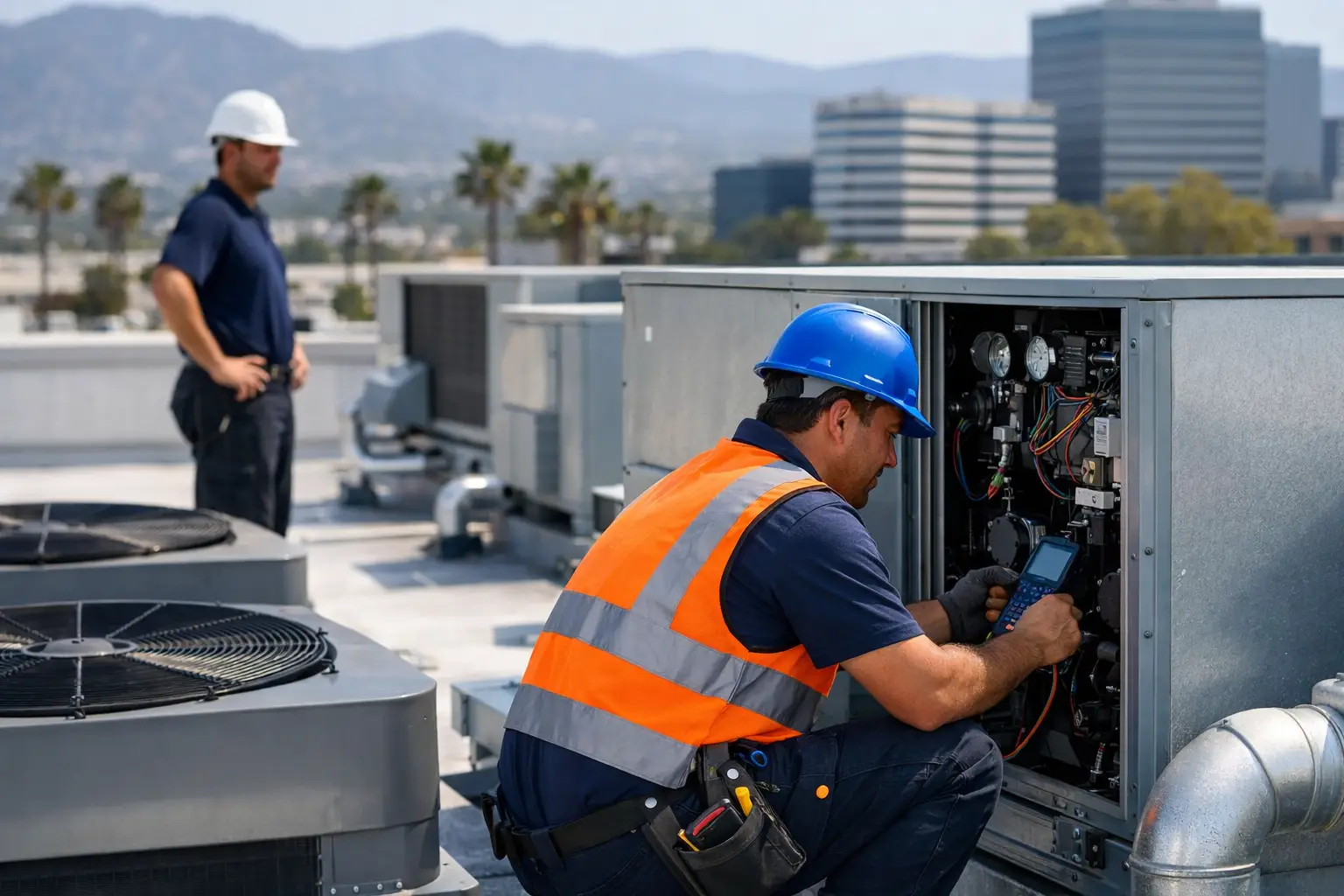
When a rooftop unit fails in the middle of a workday, comfort is only part of the problem. Employees get distracted, customers leave sooner, equipment can overheat, and a small HVAC issue starts affecting revenue. That is why commercial hvac service Burbank business owners rely on needs to be fast, accurate, and built around long-term reliability – not a temporary patch.
Commercial systems work harder than most people realize. Offices, retail spaces, restaurants, medical suites, and mixed-use properties all place different demands on heating and cooling equipment. A system that looks fine from the outside can still struggle with airflow, uneven temperatures, short cycling, thermostat issues, dirty coils, or aging components that are close to failure.
For business owners and property managers, the real goal is simple. You want a building that stays comfortable, runs efficiently, and does not create surprise downtime. Good HVAC service supports that goal by catching problems early, repairing systems correctly, and helping you make smart decisions when repair is no longer the best investment.
What commercial HVAC service in Burbank should actually cover
Commercial HVAC is not the same as residential service with a bigger unit. The equipment is often more complex, the usage patterns are heavier, and the cost of disruption is higher. A service call should begin with a clear diagnosis, not guesswork.
That means checking the system as a whole. A technician should look at controls, electrical components, refrigerant levels, filters, coils, blowers, motors, drains, and overall airflow performance. In many commercial properties, the complaint is not just that the system stopped working. It may be that one suite is too warm, another is too cold, or the unit runs all day without properly conditioning the space.
The right fix depends on the building and the equipment. Sometimes the issue is straightforward, such as a failed capacitor, a damaged contactor, or a thermostat problem. Other times, the HVAC system is reacting to duct leakage, neglected maintenance, incorrect sizing, or poor installation from years earlier. That is where experience matters. You need someone who can separate the symptom from the real cause.
Why speed matters, but accuracy matters more
In commercial properties, quick response is important. No one wants employees calling in complaints all afternoon or customers walking into a stuffy space. But speed without proper diagnosis can become expensive.
A rushed repair may get the unit running for a few days while leaving the underlying problem untouched. For example, replacing a failed motor without addressing dirty coils or excessive static pressure can lead to another breakdown. Recharging refrigerant without finding the leak may restore cooling briefly, but it does not solve the issue.
Reliable commercial hvac service Burbank property owners can depend on balances urgency with thorough workmanship. The immediate goal is to restore safe operation when possible. The larger goal is to reduce repeat service calls and help the equipment operate the way it should.
Common commercial HVAC problems in Burbank properties
Burbank businesses deal with long cooling seasons, warm afternoons, and the kind of daily use that exposes weak points in older systems. Even quality equipment starts to show strain when maintenance is delayed or parts wear out.
One of the most common issues is weak or uneven airflow. This often shows up as hot spots, cold spots, or rooms that never seem to match the thermostat setting. Dirty filters are one possible cause, but not the only one. Blower issues, duct restrictions, failing motors, and control problems can all affect airflow.
Another frequent problem is short cycling, where the system turns on and off too often. That can increase wear, reduce efficiency, and make indoor temperatures less stable. The reason may be as simple as a thermostat placement issue or as serious as an oversized unit or failing compressor.
Electrical failures are also common in commercial systems, especially during periods of heavy demand. Capacitors, relays, wiring connections, and control boards all take a beating over time. If a unit trips breakers, struggles to start, or shuts down unexpectedly, the repair should not stop at replacing one part. The technician should determine why that part failed in the first place.
Then there is the issue many businesses overlook until complaints increase – indoor air quality. Dirty filters, neglected coils, poor ventilation, and moisture problems can all affect how a commercial space feels. In some settings, that affects more than comfort. It can impact employee satisfaction, customer experience, and how clean the building feels overall.
Repair or replacement depends on the full picture
Not every struggling commercial unit needs to be replaced. At the same time, not every repair is a good investment. The right answer depends on age, condition, operating cost, and how often the system has been failing.
If the equipment is relatively new and the problem is isolated, repair is usually the practical choice. A qualified repair can restore performance and extend service life. But if the system is older, inefficient, and requiring frequent service, replacement may save money over time.
There is also a middle ground that gets missed. Some properties do not need a full replacement right away but do need a serious correction to installation issues, controls, or neglected maintenance items. In those cases, honest service matters. A contractor should explain what is necessary now, what can wait, and what to expect going forward.
That customer-first approach is what many business owners are looking for. They do not need pressure. They need straightforward recommendations that fit the building, the workload, and the budget.
Preventive maintenance is where uptime is protected
The best commercial HVAC repair call is the one you avoid during peak season. Preventive maintenance helps reduce emergency breakdowns, improve efficiency, and extend equipment life. It also gives property owners a clearer picture of system condition before a minor issue becomes a major interruption.
A proper maintenance visit should include more than changing filters. Commercial equipment needs inspection, cleaning, testing, and adjustment. Coils should be checked, electrical connections tightened, motors inspected, drains cleared, and controls verified. Refrigerant performance and airflow should also be reviewed, especially in buildings where comfort complaints happen regularly.
Maintenance is not glamorous, but it protects operating hours. For retail spaces, offices, and managed properties, that predictability matters. It is easier to schedule service on your terms than to deal with an unexpected outage on the hottest day of the month.
Choosing a commercial HVAC partner, not just a contractor
Business owners usually learn this after a bad service experience. The lowest estimate is not always the lowest cost. If work is rushed, poorly explained, or done without attention to the full system, the same problem often comes back.
A better commercial HVAC provider brings licensed, insured service, skilled technicians, and clear communication. You should know what was found, what was repaired, and whether there are warning signs to monitor. If replacement is recommended, the proposal should match the property’s needs rather than push a one-size-fits-all solution.
Installation quality matters just as much as equipment quality. Even a premium system can underperform if it is installed incorrectly, set up with poor airflow, or matched to the wrong application. On the other hand, a well-installed system with regular service can deliver dependable performance for years.
That is why many local businesses want a contractor they can call for both immediate repairs and long-term planning. Candid Heating & Air Conditioning, Inc. works with that mindset – practical service, honest recommendations, and workmanship built to hold up over time.
What to do when your system starts showing warning signs
If your commercial HVAC system is making unusual noises, producing weak airflow, cooling unevenly, or causing utility costs to climb, do not wait for a complete shutdown. Early service usually gives you more options. It may mean a targeted repair instead of an after-hours emergency or a full replacement under pressure.
It also helps to document patterns. If certain rooms are always uncomfortable, if the issue happens only in the afternoon, or if the unit struggles during heavy occupancy, that information can help narrow down the cause. Good service is not just about tools and parts. It is about understanding how the building is actually being used.
A dependable HVAC company should make this process easier, not harder. You want answers that are clear, realistic, and based on experience. Whether the need is repair, maintenance, or planning for replacement, the right service should protect comfort, system life, and business continuity.
When your building depends on reliable heating and cooling, small issues are rarely just small issues. Taking care of them early is one of the smartest ways to protect your property, your people, and your day-to-day operations.