
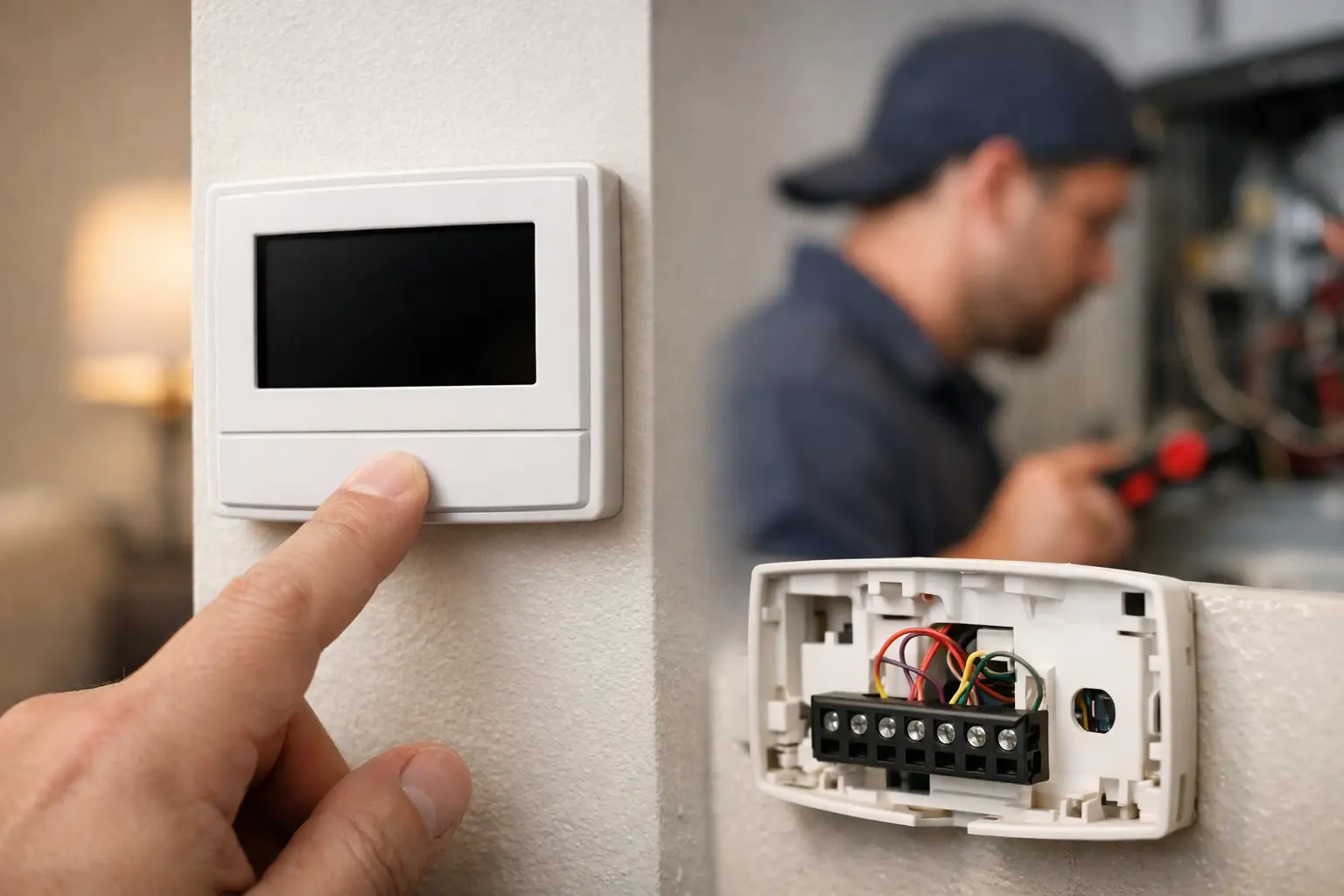
A thermostat can seem like a small part of your HVAC system until the house will not cool, the heat will not turn on, or the display suddenly goes blank. If you are asking, why is thermostat not working, the answer is usually one of a few common issues – power loss, incorrect settings, wiring problems, or a larger HVAC system fault that only looks like a thermostat problem.
The good news is that some thermostat problems are simple to identify. The less good news is that a thermostat is also the control center for your heating and cooling system, so guessing can waste time and sometimes make the problem worse. A careful check can help you separate a quick fix from a repair call.
Why is thermostat not working in the first place?
In most homes and small commercial spaces, the thermostat is constantly sending signals to your furnace, air conditioner, or heat pump. When that communication is interrupted, the system may stop responding, run at the wrong time, or fail to reach the set temperature.
Sometimes the thermostat itself is the problem. Other times, the thermostat is doing its job, but the equipment on the other end is not responding. That distinction matters, because replacing a thermostat will not solve a tripped breaker, a blown low-voltage fuse, or a failing control board.
Start with the simplest thermostat checks
Before assuming the thermostat has failed, look at the basics. Many service calls begin with settings that were changed accidentally, weak batteries, or a screen that appears dead because the system has lost power.
Check whether the thermostat display is on. If the screen is blank, the issue may be dead batteries, a tripped breaker, a blown fuse in the air handler or furnace, or loose thermostat wiring. If the display is on, make sure the system is set to the right mode. Cooling mode will not start your heat, and heat mode will not trigger your AC.
Then check the set temperature. It sounds obvious, but a thermostat set too close to room temperature may not call for heating or cooling at all. For cooling, lower the setting several degrees below the current room temperature. For heating, raise it several degrees above room temperature and wait a minute to see if the system responds.
Fan settings matter too. If the fan is set to ON instead of AUTO, air may circulate even when the system is not actively heating or cooling. That can make it seem like the thermostat is confused when the real issue is simply a setting change.
Battery problems are more common than people think
Many thermostats use batteries even when connected to household power. As batteries weaken, the display may dim, the thermostat may lose programming, or the system may stop responding correctly.
If your thermostat takes batteries, replace them with fresh ones and see whether the screen and controls return to normal. This is one of the easiest checks to make and one of the most overlooked.
That said, batteries are not the answer for every blank screen. If a new set does nothing, there may be a wiring or power issue behind the thermostat or at the HVAC equipment itself.
A blank thermostat screen often points to a power issue
When a thermostat goes completely dark, many property owners assume the unit has failed. Sometimes that is true, but often the thermostat is simply not receiving power.
Start at the electrical panel and look for a tripped breaker tied to the furnace, air handler, or outdoor condenser. Reset it once if needed. If it trips again, stop there. Repeated breaker trips usually mean there is a deeper electrical or equipment problem that should be handled by a qualified technician.
Some systems also have a condensate safety switch. In Southern California, this can still come into play when AC systems produce drainage problems. If the drain line backs up, the safety switch may shut the system down to prevent water damage. In that case, the thermostat may appear unresponsive even though the real issue is a clogged drain.
Wiring issues can interrupt thermostat communication
A thermostat depends on low-voltage wiring to communicate with the HVAC system. If one wire loosens, corrodes, or breaks, the thermostat may stop controlling part or all of the system.
This can happen after years of vibration, after remodeling work, or after a thermostat replacement that was not wired correctly. You might notice the fan works but the cooling does not, or the heat comes on but will not shut off properly. Those symptoms often point to miswired or damaged control wiring.
Wiring issues are one area where caution matters. Thermostat wiring is low voltage, but improper handling can still damage the thermostat, blow a control fuse, or create more expensive problems. If you remove the faceplate and see loose, frayed, or disconnected wires, it is usually best to have the system tested rather than trying to guess which wire goes where.
Sometimes the thermostat is not the real problem
One of the most common misunderstandings in HVAC service is assuming the thermostat is bad because the system is not responding. In reality, the thermostat may be sending the signal correctly while the furnace, air handler, heat pump, or AC is failing to start.
A dirty filter can cause system issues that look like thermostat trouble. So can a frozen evaporator coil, a failed capacitor, an ignition problem, a clogged condensate line, or a safety switch that has shut the unit down. If the thermostat clicks or shows that it is calling for heating or cooling but nothing happens, the problem may be elsewhere in the system.
This is especially common with older equipment. An aging furnace or air conditioner can become inconsistent, turning a simple thermostat call into delayed starts, short cycling, or no operation at all.
Why is thermostat not working after replacement?
If the thermostat stopped working right after a new one was installed, installation error is high on the list. Not every thermostat is compatible with every HVAC system. Some smart thermostats require a common wire, while some heat pump systems need very specific terminal connections.
Even a high-quality thermostat can perform poorly if it is installed on the wrong type of system, programmed incorrectly, or mounted with improper wiring. In some cases, the thermostat itself is fine, but the setup menu was configured for a conventional furnace when the building actually has a heat pump.
Placement also matters. If a thermostat is installed near direct sunlight, supply vents, drafty doors, or heat-producing appliances, it may read the room incorrectly and cycle the system at the wrong times. That can make the thermostat seem broken when the real issue is poor location.
Smart thermostats add convenience but also complexity
Smart thermostats can improve control and energy use, but they create a few extra failure points. Wi-Fi issues, software glitches, app sync problems, and power-stealing behavior can all affect operation.
If a smart thermostat is offline, check whether the HVAC system still runs manually from the wall unit. If it does, the issue may be with network connection or device settings rather than the heating and cooling equipment itself.
Still, a smart thermostat should not be blamed for every comfort problem. If the system runs but does not cool or heat properly, you may be dealing with an equipment issue, not a control issue.
When you can troubleshoot and when you should call
There is a practical line between safe homeowner checks and repairs that need proper testing. It makes sense to check batteries, settings, breaker status, and whether the air filter is badly clogged. Those steps are simple and can rule out common causes quickly.
Once the issue involves wiring, repeated breaker trips, inconsistent operation, or a thermostat that appears to work but does not control the system correctly, professional diagnosis is the better move. HVAC controls are interconnected. A trained technician can determine whether the failure is in the thermostat, transformer, low-voltage fuse, control board, safety switch, or the heating and cooling equipment itself.
For homeowners and property managers, that saves time and avoids replacing parts that were never the problem. At Candid Heating & Air Conditioning, Inc., that is often where experience matters most – finding the actual cause instead of treating the thermostat as the automatic culprit.
A working thermostat depends on the whole system
If you keep asking, why is thermostat not working, think of the thermostat as one piece of a larger control chain. The screen, settings, wiring, electrical supply, drainage safety devices, and HVAC equipment all have to work together for heating and cooling to respond the way they should.
A quick battery change or setting correction may solve it. Other times, the thermostat is simply the first place where a bigger system problem becomes visible. The smartest next step is not always replacing the thermostat. It is making sure the entire system is checked carefully so your comfort, safety, and equipment reliability are protected.