
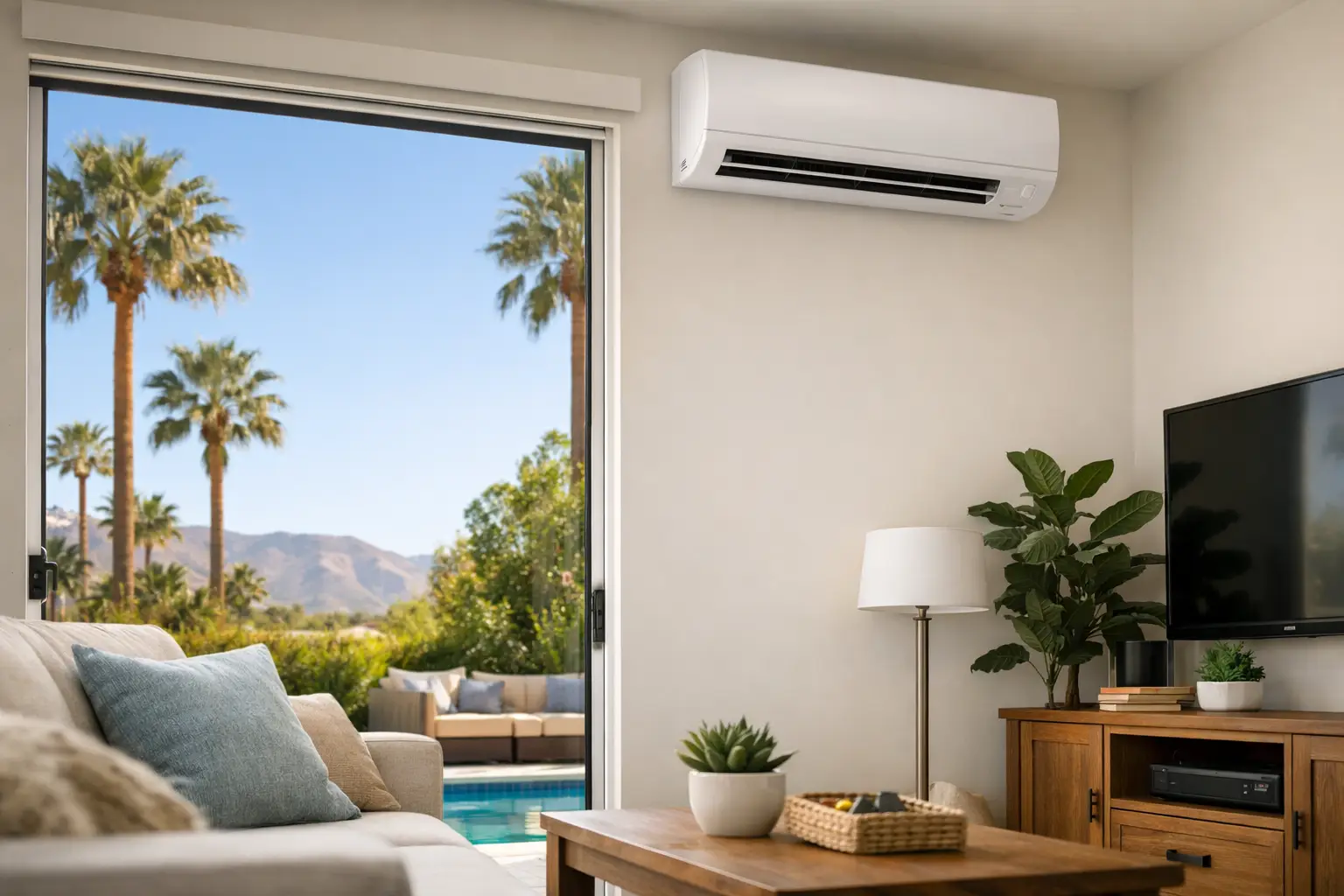
A ductless mini split review should answer more than whether a unit blows cold air. For homeowners and property managers in Southern California, the real question is whether the system will cool the rooms that matter, manage winter heating needs, fit the property correctly, and hold up over time. A properly selected and installed mini split can be an excellent comfort solution. A poorly planned one can leave you with uneven temperatures, visible equipment in the wrong places, and an investment that does not perform as expected.
What a Ductless Mini Split Does Well
A ductless mini split uses an outdoor condenser connected to one or more indoor air handlers. Instead of moving conditioned air through large ducts, each indoor unit delivers heating and cooling directly to its assigned space. This setup makes mini splits especially useful where ductwork is missing, undersized, leaking, or impractical to add.
For a converted garage, home addition, ADU, sunroom, upstairs bedroom, or small office suite, a single-zone mini split can provide targeted comfort without extending an existing central system. Multi-zone systems can serve several rooms from one outdoor unit, giving occupants individual temperature control in each area.
That room-by-room control is one of the strongest reasons people choose ductless equipment. A bedroom can be cooler at night while a rarely used guest room is set back. In a commercial setting, separate offices or work areas can be adjusted without making the entire building too cold or too warm.
Mini splits are also known for efficient operation. Many systems use inverter-driven compressors that adjust output rather than repeatedly switching fully on and off. When the equipment is properly sized, that steady operation can help maintain more consistent indoor temperatures and reduce unnecessary energy use.
The Trade-Offs to Consider Before Installing
Ductless systems are not automatically the best answer for every home. The right choice depends on the building layout, insulation, electrical capacity, number of rooms, and how the space is used.
The most noticeable trade-off is the indoor equipment. Wall-mounted air handlers are common, and while modern units are relatively compact, they are still visible. Ceiling cassettes, floor-mounted units, and concealed ducted air handlers may be options for some properties, but they can increase installation complexity and cost.
A multi-zone system also deserves careful planning. One outdoor unit can serve several indoor zones, which can save space outside, but its capacity must be distributed correctly. If every zone calls for maximum cooling at the same time during a hot San Fernando Valley afternoon, the system needs enough capacity to meet that demand. Oversimplifying this calculation is a common reason systems disappoint homeowners.
Initial cost can be another concern. A quality mini split installation includes more than mounting equipment and connecting lines. It may involve electrical work, refrigerant line routing, condensate drainage, wall penetrations, equipment pads or brackets, permits, and proper commissioning. The lowest quote may leave out work that is necessary for safety, code compliance, appearance, or long-term performance.
Maintenance is straightforward but not optional. Filters need regular cleaning, and the indoor coil, blower wheel, drain line, and outdoor unit should be inspected periodically. A neglected wall unit can develop reduced airflow, odors, drainage problems, or lower efficiency. Mini splits are reliable equipment when they receive the same practical attention expected from central air conditioning.
Ductless Mini Split Review: Comfort and Efficiency
The best ductless mini split review looks at daily comfort, not just a manufacturer efficiency rating. High-efficiency equipment has value, but the rating alone does not guarantee lower operating costs. A system that is oversized, poorly located, incorrectly charged, or installed with inadequate drainage may not deliver the results its specifications suggest.
When designed well, ductless equipment can provide very even comfort in the room where the air handler is installed. It responds quickly, operates quietly, and avoids the duct losses that affect many older homes. This is particularly helpful in homes with hot upstairs rooms, additions that never seem to cool down, or spaces far from the central air handler.
However, an open doorway does not turn one indoor unit into a whole-house system. Air can move between rooms, but it will not distribute as predictably as a properly designed ducted system. Bedrooms with closed doors, long hallways, and divided floor plans often need separate zones or a different approach.
Heating performance also matters locally. Modern heat pump mini splits can provide effective heat during Southern California winters, often with excellent efficiency. Still, the system should be selected for the home’s actual heating load, not just its cooling needs. A qualified contractor should consider insulation, window exposure, ceiling height, occupancy, and the condition of the building envelope before recommending capacity.
Sizing Is Not a Guess
Square footage is only one part of sizing a mini split. Two rooms of the same size can have very different loads based on west-facing glass, vaulted ceilings, poor insulation, kitchen heat, or direct sun exposure. A unit that is too small may run continuously and struggle during peak weather. One that is too large may cycle inefficiently or fail to control humidity as well as it should.
A professional load assessment provides a more dependable starting point. It also helps determine whether one zone, multiple zones, or a hybrid system makes the most sense. In some homes, keeping central air for the main living areas and adding a mini split to a difficult room is more practical than replacing everything at once.
Installation Quality Has a Lasting Impact
Mini splits have fewer large duct connections, but they are not simple plug-in appliances. Refrigerant piping must be correctly sized, pressure-tested, evacuated, and charged according to manufacturer requirements. Electrical connections need proper protection, drains must carry condensate safely away, and indoor units must be mounted level and securely.
The location of the outdoor condenser matters as well. It needs adequate clearance for airflow and service access, a stable mounting surface, and a placement that considers noise, sun exposure, and neighborhood or property requirements. In tight Los Angeles-area lots, thoughtful planning can prevent a clean installation from becoming an eyesore or a future service challenge.
Single-Zone vs. Multi-Zone Systems
A single-zone mini split has one outdoor unit and one indoor unit. It is often the clearest solution for one problem area, such as an ADU, detached office, converted garage, or primary bedroom. It is generally easier to design because the equipment is focused on one load.
A multi-zone system connects multiple indoor units to one outdoor condenser. This can be a good fit for homes without ducts or for properties that need separate comfort control in several rooms. It can reduce the amount of outdoor equipment, but it requires more detailed design and may be more expensive to repair if the shared outdoor unit has an issue.
There is no universal winner. A homeowner who needs cooling in one upstairs bedroom may benefit from a single-zone installation. A property manager renovating several small offices may find a multi-zone system more practical. The right configuration comes from the property, the budget, and the comfort goals.
Questions to Ask Before You Buy
Before approving a mini split installation, ask how the equipment size was determined and where each indoor and outdoor component will be placed. Ask what electrical, drainage, and permit work is included, as well as how the installer will protect the home during wall penetrations and line-set routing.
It is also reasonable to ask about maintenance requirements, warranty coverage, labor warranty terms, and the expected service access for each unit. Clear answers are a good sign that the installation has been planned rather than priced as a generic package.
For homeowners in Northridge, Sherman Oaks, Encino, and nearby communities, local climate and home construction can make a major difference in system selection. Candid Heating & Air Conditioning approaches mini split recommendations by looking at the space itself, not just the equipment catalog. That helps keep the focus where it belongs: dependable comfort, safe installation, and a system that fits the property.
A mini split is often a smart investment when it solves a specific comfort problem with the right design behind it. Take the time to evaluate the room, the layout, and the quality of the proposed installation. The equipment may be ductless, but the decision should never be without careful planning.