
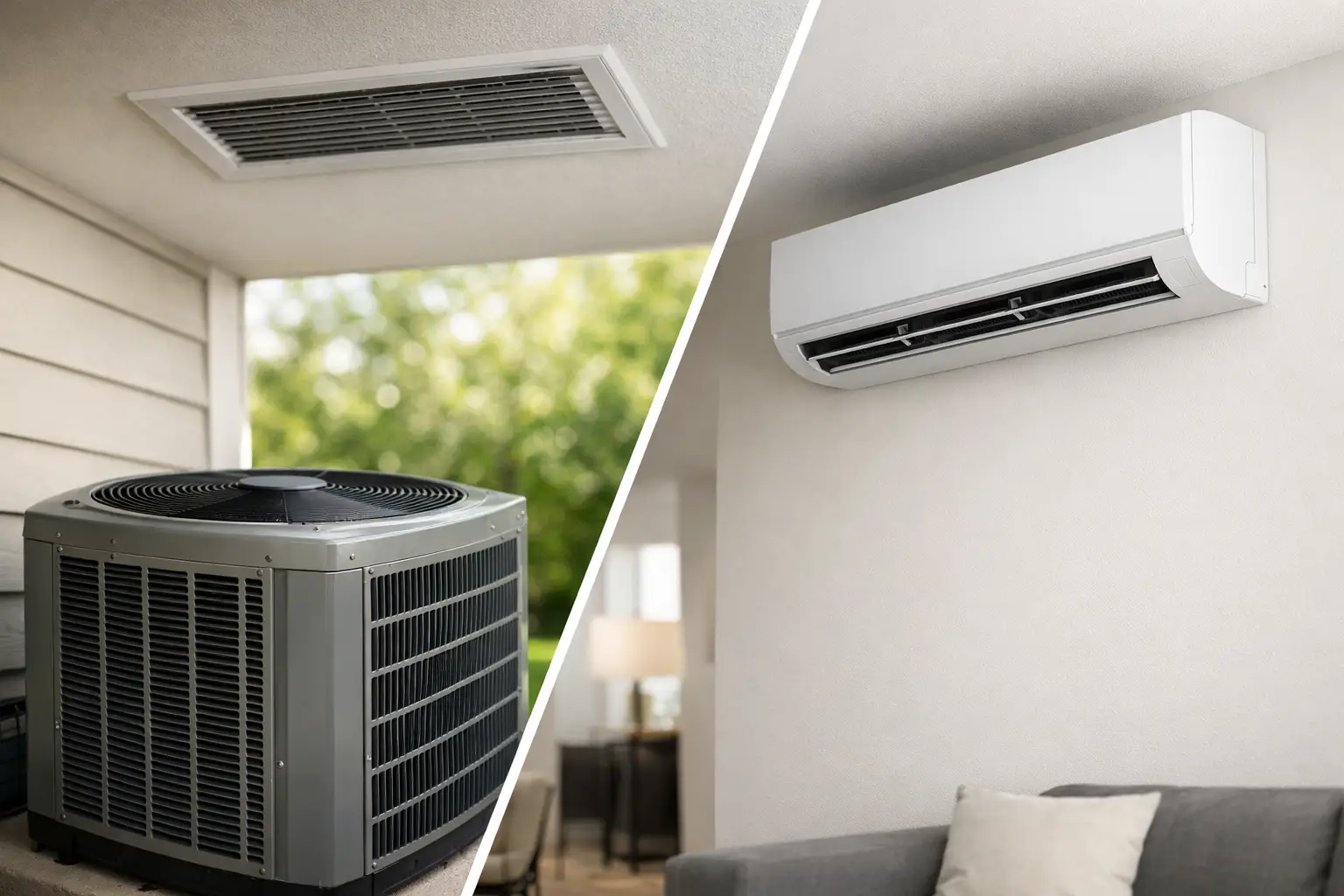
If your current AC is struggling through another Southern California heat spell, the question usually gets practical fast: should you replace it with central air, or switch to a ductless system? When homeowners compare central air vs mini split options, the right answer often comes down to how your property is built, how you use each room, and how much flexibility you want over time.
Both systems can cool a space well when they are properly sized and installed. The bigger difference is how they deliver comfort, what they cost to install, and how they fit your building. A system that works great in one house can be the wrong choice for the one next door.
Central air vs mini split: the basic difference
Central air uses one main indoor unit, one outdoor condenser, and a network of ducts to move cooled air throughout the property. It is designed to treat the whole home or building as one connected system, even if zoning controls are added later.
A mini split also has an outdoor unit, but instead of pushing air through ducts, it connects to one or more indoor air handlers mounted in specific rooms or zones. Each indoor unit cools the area where it is installed. That makes mini splits especially useful when different rooms have different comfort needs.
This difference matters more than most people expect. With central air, you are investing in whole-home distribution. With a mini split, you are investing in room-by-room control.
When central air makes more sense
Central air is often the better fit when a property already has ductwork in good condition. If the ducts are properly sealed, sized, and located, central air can cool the entire home evenly without requiring visible wall-mounted units in multiple rooms.
For many homeowners, that cleaner look matters. Central air keeps most of the equipment out of sight, with supply vents and return grilles doing the work quietly in the background. In larger homes, this can feel more natural than having several indoor heads installed throughout the house.
Central air can also be the stronger option if you want one system tied into a furnace or an existing forced-air setup. If your property already relies on ducts for heating, keeping cooling on the same delivery path may be more straightforward and cost-effective than building a separate ductless layout.
That said, central air depends heavily on the quality of the duct system. If ducts leak, run through very hot attic spaces, or were poorly designed, efficiency and comfort can drop. A high-quality AC unit cannot fully overcome bad ductwork.
When a mini split is the better choice
Mini splits are a strong fit for properties without existing ducts, room additions, converted garages, older homes, and areas that never seem to stay comfortable. They are also popular in spaces where installing or extending ductwork would be disruptive or too expensive.
One of the biggest advantages is zoning. You can cool the rooms you are actually using instead of conditioning the whole building the same way all day. In a home where family members prefer different temperatures, that can make a real difference in comfort and operating cost.
Mini splits also help solve uneven cooling. If a second-floor bedroom gets hotter than the rest of the house, or a detached office needs its own control, a ductless unit can target that problem directly.
The trade-off is visibility. Some people do not mind the indoor wall units at all. Others prefer the less noticeable appearance of central vents. Neither concern is minor if you plan to live with the system for years.
Cost depends on the property, not just the equipment
A lot of people start with the assumption that mini splits are always cheaper or that central air is always the premium option. In real projects, the answer is not that simple.
If your home already has usable ducts, central air installation may be the more practical and affordable path. If your property has no ducts at all, adding central air can become a much larger project once you include duct design, cutting access, patching finishes, and labor.
Mini splits can avoid those duct installation costs, but the total price still rises as you add more indoor zones. A single-zone mini split for one room is very different from a multi-zone system serving an entire house.
This is why honest recommendations matter. A contractor should look at the building, insulation, layout, electrical capacity, and comfort problems before suggesting a system. Equipment price alone does not tell you which option gives better long-term value.
Efficiency and utility bills
Mini splits are often highly efficient because they avoid duct losses and allow for zone control. In a home where only part of the space is occupied during the day, that can translate into meaningful savings.
Central air can still be efficient, especially in a well-sealed home with properly installed ducts and modern equipment. But if conditioned air is leaking into an attic or crawl space, your system may run longer than necessary.
It also depends on how you live. If you want the entire home comfortable most of the time, central air may perform very well and feel simpler to manage. If your household only uses certain rooms at certain hours, mini split zoning may have the edge.
Efficiency on paper and efficiency in real life are not always the same. Sizing, installation quality, airflow, refrigerant charge, thermostat setup, and maintenance all affect actual performance.
Comfort is more than temperature
Homeowners often focus on cooling power, but comfort includes consistency, airflow, noise level, and control. A central air system can provide balanced comfort throughout a larger home when the duct design is right. It can also filter and circulate air across the whole structure in a familiar way.
Mini splits offer more individualized control. If one person likes the bedroom cooler and another prefers the living room warmer, that flexibility is hard to beat. They also tend to run quietly, which can be a major benefit in offices, bedrooms, or studios.
On the other hand, mini splits condition the zones where they are installed. Air does not move through the property in the same way central air does. In more closed-off floor plans, that can matter.
Installation and disruption
Central air installation can be straightforward in a home that already has suitable ductwork. In a property without ducts, it may involve a much more invasive process. That can mean opening walls or ceilings, routing large duct runs, and working around framing and access limitations.
Mini split installation is usually less disruptive because it uses small refrigerant lines instead of large ducts. That makes it appealing in finished homes, historic properties, or occupied spaces where minimizing construction matters.
For property managers and business owners, that lower disruption can be a deciding factor. In some cases, keeping the building functional during installation matters just as much as equipment efficiency.
Maintenance and long-term service
Both systems need regular maintenance to perform well. Central air requires attention to filters, coils, drains, refrigerant levels, blower components, and duct condition. Mini splits need coil cleaning, filter cleaning, drain inspection, and service for each indoor head.
The difference is partly in complexity. A central air system has one main indoor cooling point for the whole building. A multi-zone mini split has several indoor components, and each one needs to stay clean and operating properly.
Neither system should be treated as install-and-forget equipment. Good maintenance protects efficiency, helps prevent breakdowns, and extends equipment life.
What works best in Southern California homes
In many Los Angeles and San Fernando Valley properties, the best answer comes from the age and layout of the home. Newer homes with existing forced-air systems often continue to do well with central air replacement. Older homes, additions, and converted spaces are often excellent candidates for mini split installation.
This is also a region where comfort needs can change room by room. West-facing rooms, upstairs spaces, and home offices often need different treatment than the rest of the house. That is one reason mini splits have become so common in local retrofit projects.
At the same time, many families still prefer the whole-home feel and hidden design of central air. If the duct system is in good shape, that preference can make perfect sense.
So which one should you choose?
If you want whole-home cooling through existing ducts, a cleaner visual setup, and one integrated system, central air may be the better fit. If you want zoning, flexibility, easier installation without ducts, or a targeted solution for specific rooms, a mini split may be the smarter investment.
The safest way to decide is to look at the building first and the equipment second. A dependable HVAC recommendation should reflect your layout, comfort goals, budget, and how long you plan to stay in the property. That is how you avoid paying for the wrong system and start getting the comfort you expected in the first place.
A good HVAC system should feel like it belongs in your space, not like a compromise you learn to tolerate.